Who is convening it
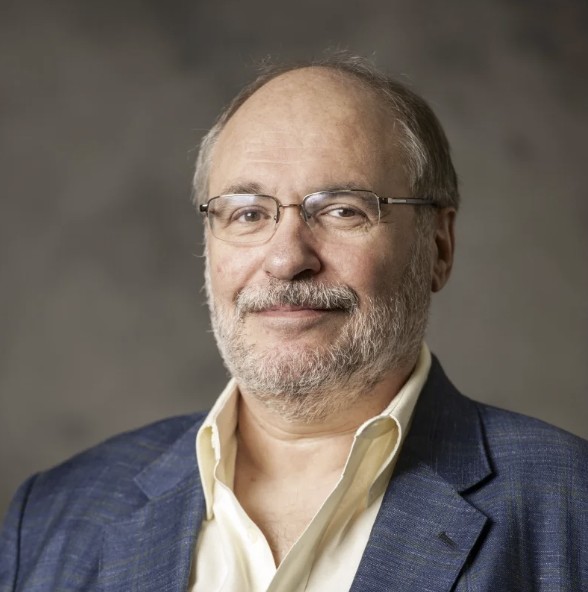
Sergei Nirenburg
Rensselaer Polytechnic Institute
Language, Embodiment, Intelligence, Agency Lab
Sergei Nirenburg co-directs RPI's LEIA Lab, which develops language-endowed intelligent agents whose knowledge-based semantics let them not only act but account for their own reasoning, with explainability treated as the precondition for trust rather than a post-hoc gloss. His current work centres on the OntoAgent cognitive architecture, applied across clinical medicine, cognitive robotics, forensics and descriptive linguistics, and he is the principal developer of HARMONIC, the lab's cognitive robotic architecture. He is also a co-founder of OntoAgent, a new startup. His books include Ontological Semantics, Linguistics for the Age of AI, and Agents in the Long Game of AI: Computational Cognitive Modeling for Trustworthy, Hybrid AI, which argues the case for deep, knowledge-based agents in an era dominated by scale.

Sanjay Oruganti
Rensselaer Polytechnic Institute
Language, Embodiment, Intelligence, Agency Lab
Sanjay Oruganti is a Research Scientist in the LEIA Lab at RPI and the co-developer and lead of HARMONIC, a content-centric cognitive robotic architecture that puts an OntoAgent reasoning layer in charge of a robot's perception, decision making and control, so that a robot can act as a teammate that explains itself rather than an executor that cannot. His interest is squarely in the integration problem this workshop is convened around: how a symbolic architecture orchestrates neural and generative components without inheriting their opacity, and what has to be true of a robot before a person can reasonably trust it in a shared task. He came to this from multi-robot systems, where his doctoral work on knowledge transfer through behaviour trees addressed how robots pass learned competence to one another, directly and by eavesdropping on the communication of others. His current work spans explanatory perception, reasoning and action in robotic teammates, and automated knowledge acquisition for cognitive agents using large language models.
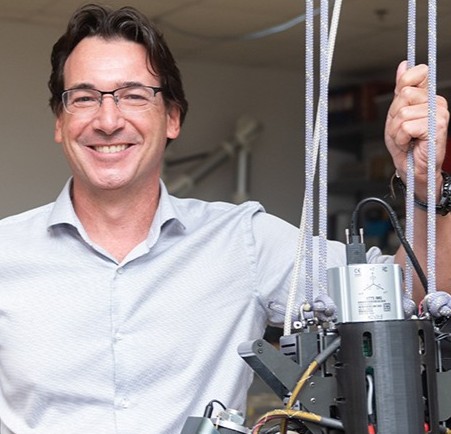
Luis Sentis
The University of Texas at Austin
Human Centered Robotics Laboratory
Luis Sentis directs the Human Centered Robotics Laboratory at UT Austin. The whole-body control framework he developed with Oussama Khatib remains a standard for coordinating contact, balance and manipulation in high-degree-of-freedom robots, and his lab has built and studied a long line of platforms including Dreamer, the point-foot biped Hume, and the Mercury and DRACO series, as well as leading UT Austin's contribution to the DARPA Robotics Challenge with NASA's Valkyrie humanoid. Current work spans dynamic locomotion in confined spaces, embodiment-aware skill learning across robot morphologies, exoskeletons, and safety guarantees for robots operating among people. He is a founding member and advisor of Apptronik, the humanoid company spun out of his lab's NASA-sponsored work.
What it is about
Developing robots that can operate as full-fledged members of human-robot teams is a core objective of R&D in robotics today. The emergence of agentic AI and the growing influence of neurosymbolic AI make it incumbent on the cognitive robotics community to assess their impact on integrating intentionality and reasoning with embodiment and perception. Machine learning has expanded what robots can perceive and control, but cognitive modeling, drawing on symbolic knowledge, commonsense reasoning, and ontologically-grounded perception, is widely seen as the necessary complement for robots that are robust, intentional, trustworthy, explainable, and socially aware.
The workshop brings together experts and students of cognitive robotics, agentic and neurosymbolic AI, and adjacent fields to assess what current approaches do well and where they fall short, connect researchers across cognitive systems, embodied intelligence, human-robot interaction, and multi-robot collaboration, and sketch a roadmap for the next phase of R&D in cognitive robotic teaming. Newcomers and established contributors from academia and industry alike are welcome.
What the workshop covers
- Cognitive agent architectures as orchestrators
- Cognitive agents as high-level controllers, orchestrating heterogeneous AI modules and integrating perception, reasoning, planning, and action execution.
- Neurosymbolic integration
- Symbol grounding that links perceptual data to symbolic representations; hybrid reasoning combining learned models with knowledge-based inference.
- Long-horizon & hierarchical planning
- Planning under uncertainty with commonsense knowledge; multi-step, multi-agent coordination bridging short-term control and long-term goals.
- Human-robot teaming & theory of mind
- Modeling others' beliefs, goals, and intentions; role allocation and adaptive collaboration; socially aware, explainable interaction.
- Perception & action grounding
- Mapping sensorimotor signals to symbolic structures; natural language grounding; situated understanding of environments and objects.
- Knowledge resources
- Ontologies, lexicons, and world models for robotics; introspection, self-modeling, and knowledge repair.
- Learning
- Learning by understanding through ontological interpretation of percepts; integrating supervised, unsupervised, and reinforcement learning.
- Trust, explainability & ethics
- Transparent reasoning and communicable decision-making; self-explanation, accountability, and trustworthy cognitive architectures.
- Benchmarks, evaluation & resource sharing
- Standardized tasks and metrics for human-robot collaboration; open-source tools and platform-independent frameworks.
Get in touch
For questions about the workshop, submissions, or program, write to contact@leia-lab.com.